Last updated: May 2026
A normal blood test asks whether you are sick, not whether your body is running well. It hides five values that explained everything for me: zonulin for the gut wall, DAO for histamine, mercury as a heavy metal, intracellular ATP as a measure of your cell energy, and the omega ratio instead of individual values. Here are my real lab numbers and what they mean.
Part 2 of a two-part series. The story behind how I discovered these values after years of fatigue is in Part 1: Always Tired and Exhausted - What Was Really Missing for Me. This article goes into the depth, the numbers and the system behind it.
Table of Contents
Why Your Blood Test Is Often Asking the Wrong Question
You go to the doctor. You say you are constantly tired, your head is pounding, your stomach is acting up. You get a blood test. A few days later comes the sentence almost everyone has heard at some point: 'Everything is in the normal range, you are healthy.' And you sit there thinking: why does it not feel that way?
That is exactly where the misunderstanding lies. A standard blood test is a disease screening. It asks: are you acutely ill, is an organ about to fail, is there a fire burning somewhere? It does not ask: is your body running well, do you have enough cell energy, is your gut wall intact, are you carrying heavy metals around? Those questions are inconvenient, often not covered by insurance and require specialized labs.
I learned that the hard way. In Part 1 of this series I described how I ended up getting a deeper analysis done in the first place. Here in Part 2 I show you the five values that opened my eyes the most. With real numbers from my own findings, no health promises, no brand names.
| A standard blood test shows | A standard blood test does NOT show |
|---|---|
| Red and white blood cells | Zonulin and gut permeability (leaky gut) |
| Liver and kidney values | DAO enzyme and histamine intolerance |
| Blood sugar, basic lipids | Heavy metals like mercury and arsenic |
| Inflammation markers like CRP | Intracellular ATP and mitochondrial function |
| Standard iron and vitamin D on request | Minerals in whole blood and omega-3/6 ratio |
Value 1: Zonulin and the Leaky Gut
My zonulin was at 672.6 µU/g. The reference is below 60.1. That is 11 times the upper limit. A classic blood test said 'all clear' while my gut wall was essentially standing wide open.
What is a leaky gut, actually?
Leaky gut describes a gut whose tiny doors between the cells (the so-called tight junctions) no longer close properly. Bacterial fragments, undigested protein molecules and toxins leak into the bloodstream. Your immune system goes into permanent alert, without you feeling it in your stomach. Alessio Fasano of Harvard Medical School, the man who discovered zonulin, puts it bluntly in his widely cited review: 'all disease begins in the (leaky) gut'.
How serious is it? The strongest consensus review in the field to date (Di Vincenzo et al. 2024, over 1,000 scientific citations) describes leaky gut as a central driver of chronic inflammation, obesity, fatty liver, cardiovascular disease, inflammatory bowel disease and type 1 diabetes. A 2024 study in Pediatrics shows: zonulin rises on average 18.3 months before a coeliac diagnosis. In Hashimoto's, the most common autoimmune disease worldwide, every single patient studied showed significantly elevated zonulin (Cayres et al. 2021, p < 0.05). The link is now solidly established for depression, allergies and type 1 diabetes via the gut-brain axis.
What triggers it? The Aleman et al. 2023 review names five main triggers:
- chronic stress
- antibiotics
- regular alcohol
- highly processed foods
- NSAID painkillers like ibuprofen
Add gluten and chronic lack of sleep for sensitive people.
Is there hope? Yes, and it is measurable. The largest meta-analysis on the topic so far (Ghorbani et al. 2025, Pharmacological Research) evaluated 67 clinical trials. Result: probiotics and synbiotics lower zonulin levels by an average of 49 percent. Prebiotics significantly reduce the bacterial toxin lipopolysaccharide. The barrier can be repaired, that is now confirmed at meta-analysis level.
Sources: Di Vincenzo et al. 2024, Internal and Emergency Medicine (PubMed 37505311); Fasano A. 2020, F1000Research (PubMed 32051759); DaFonte et al. 2024, Pediatrics (PubMed 38062791); Cayres et al. 2021, Frontiers in Immunology (PubMed 33746942); Aleman et al. 2023, Molecules (PubMed 36677677); Ghorbani et al. 2025, Pharmacological Research (PubMed 40378939); Neurath et al. 2025, Lancet Gastroenterology & Hepatology (PubMed 40086468).
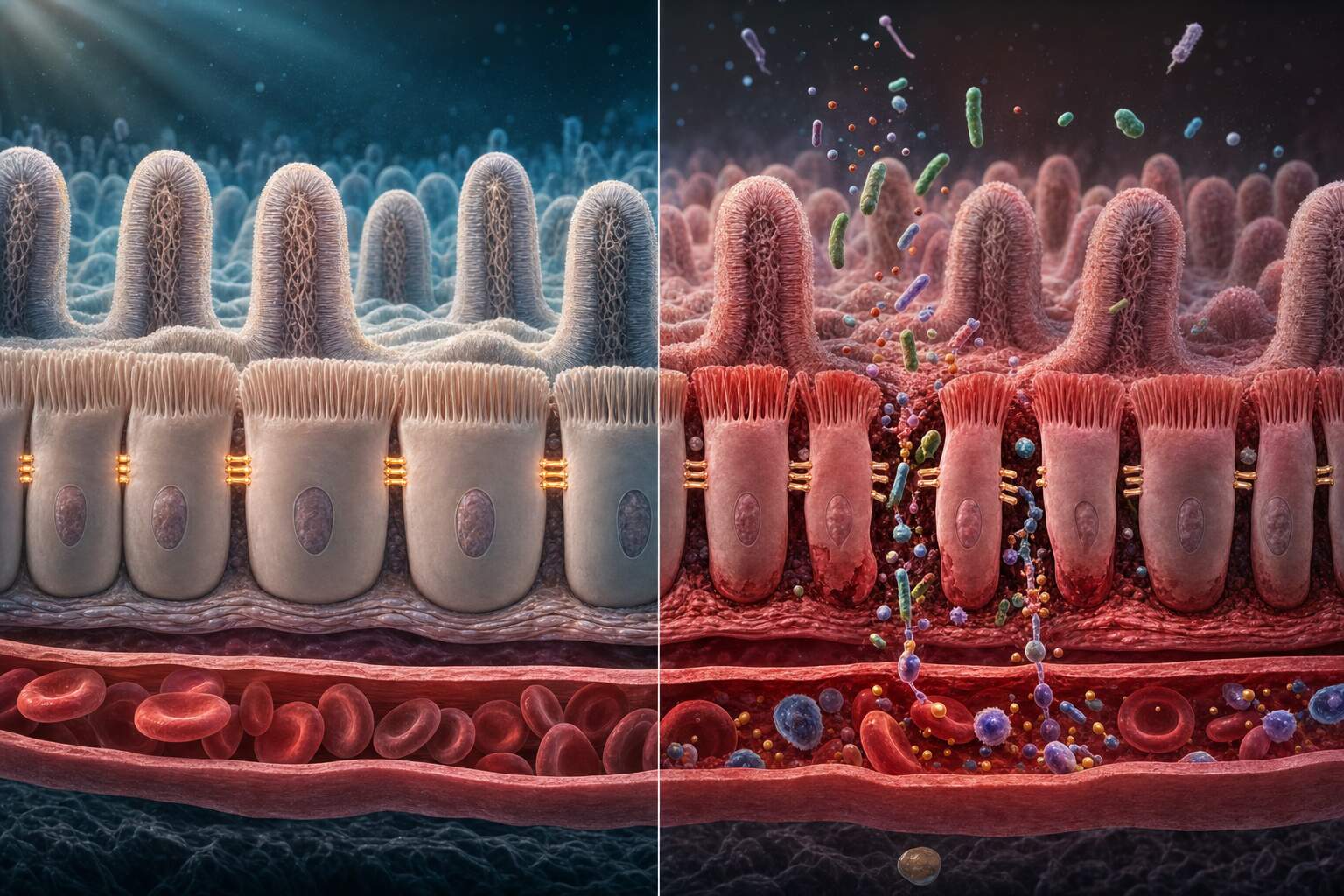
This constant immune activation is exactly why a regular blood test looked uneventful for me. The body compensates for inflammation for years until it surfaces elsewhere, as fatigue, allergies or gut symptoms.
The German Federal Institute for Risk Assessment explains that the gut barrier and its permeability play a central role for health (BfR). In my case the value fits perfectly with decades of gut issues, vague intolerances and that low-grade inflammation nobody had ever measured. It also explains why a simple probiotic yogurt in the morning changed so much. More background on that in Part 1.
Value 2: DAO and IgE, the Histamine Issue
My DAO was at 3.1 U/ml. The optimal range starts considerably higher, depending on the lab above 10 to 20. My IgE was at 142 kU/l against a reference below 100. Suddenly my entire life as an allergy sufferer made logical sense.
DAO stands for diamine oxidase, the enzyme that breaks down histamine in the gut. When there is too little DAO, histamine builds up. Symptoms range from a blocked nose, headaches and skin irritation to bloating, heart palpitations and diffuse exhaustion. The German broadcaster NDR explains this topic in an accessible way (NDR Health Guide). An elevated IgE is also a typical marker for an allergic predisposition.
For decades I had filed all of this under 'I am just an allergy sufferer.' Nasal polyps, house dust, pollen, plus gut issues that fit the DAO story like a hand in a glove. Nobody ever measured my DAO. It simply is not in the standard. Anyone who carries long-term allergy or gut symptoms around should at least have DAO and histamine on their radar.
Value 3: Mercury, the Hidden Heavy Metal
My mercury was at 3.0 µg/l, the limit is below 1.0. So three times elevated. Arsenic came in at 1.2 µg/l, right at the limit. Neither of these values appears in a standard check-up. They only surface when you actively look for them.
Mercury can displace trace elements like zinc, copper and selenium, slow down liver detoxification and above all disrupt the mitochondria, the energy production of your cells. The German Environment Agency provides factual information on sources and exposure (UBA). Sources are often amalgam fillings, heavy fish and seafood consumption, or environmental exposure over the years.
In my case a targeted detox has been running since January 2026. Six to seven months planned, the next control test is coming up. I document this openly, just as I did with the spike protein story. If you want to see that values really can shift when you know what you are doing, the full account is here: Eliminating spike proteins, my lab results before and after. The next mercury values will be published here just as transparently.
Value 4: ATP, Your Cell Energy
If any single value is responsible for that leaden, bone-deep tiredness, it is this one. My intracellular ATP was at 1.30 µM, the reference is above 2.5. Less than half of what would actually be considered normal. ATP is the fuel of every single cell in your body. Without enough ATP there is no muscle strength, no digestion, no clear thinking, no immune system running at full capacity.
A value like that points to a disrupted function in the mitochondria, the power plants of your cells. When the power plants are only running at half output, you can sleep like a log and still be dragging yourself around in the morning. That is exactly how I felt for years. At last there was a measurable cause for a feeling nobody had ever taken seriously.
Mitochondria get disrupted by heavy metals like mercury, by oxidative stress and by chronic inflammation. The picture starts to connect: leaky gut drives inflammation, mercury brakes the mitochondria, histamine keeps the stress dialed up, and ATP cannot keep pace anymore. You only understand why isolated fixes never worked once you can see the whole chain.
Value 5: It Is About the Ratio, Not Individual Values
The biggest lesson from all these findings: your body thinks in ratios, not in single pills. With fats, it is not only about omega-3, it is about the ratio of omega-3 to omega-6. With minerals, it is not about 'take magnesium', it is about the interplay in whole blood.
My calcium in whole blood was at 54.0 mg/l, just below the reference of 55 to 70. Magnesium 38.4 mg/l, selenium 149 µg/l, both fine because I had been topping them up deliberately. But calcium was lagging. The National Institutes of Health summarizes the role of calcium for bones, muscles and nerves in a clear, factual way (NIH Office of Dietary Supplements). Individual values say little, the ratio says everything.
And it does not stop at the gut and the minerals. My neighbour Christian Wolf, the founder of ESN and More Nutrition, put me on this track. In one conversation he told me I really had to get these blood values done, because they show where your real cardiovascular risk lies, not what a standard cholesterol test gives you. Four values he consistently looks at are worth checking:
- Apolipoprotein B (ApoB): maps the risk from atherogenic particles more precisely than classic LDL. My value was at 138 mg/dL in the upper reference range, a clear task to work on.
- Lp(a): a genetically driven lipoprotein value that raises cardiovascular risk independently. Mine was below 4 mg/dL, unremarkable. This is a value everyone should measure at least once in their life.
- High-sensitivity CRP (hs-CRP): a finer measure of inflammation than standard CRP. My value was low, no sign of systemic inflammation. Important to know, especially with vague symptoms.
- HOMA index: reveals early insulin resistance often many years before fasting glucose shows anything. More on that in the insulin data below.
Once you think in these ratios, your perspective shifts. You are no longer searching for the one guilty value, but for patterns. That is the difference between treating symptoms and working on causes.

From the Watering-Can Approach to a System
Once you understand what a normal blood test hides, you cannot go back to the watering can. No more 'just take something, it is supposed to be good for you.' Instead, a clear three-step process.
Measure first. Not guessing. Not 'someone on the internet said so.' Real labs, real values, ideally with a naturopath or doctor who can actually work with the findings.
Then supplement. Precisely what is missing, in the right dose, in the combination that fits your metabolism. For me it was not just 'more vitamin D', it was calcium in the right ratio, omega-3 in the right ratio, and at the same time reducing the mercury load so that anything I took could actually arrive.
Then measure again. Three to six months later. Black on white, see what has shifted and what has not. That turns 'feel like I am doing better' into a reliable data point. The same data-based approach I use in my business, actually with my AI assistant as an entrepreneur.
In early 2026 the next step for me was a genetic analysis. It shows predispositions, for example how my body processes specific nutrients. On its own it does not tell you much. Combined with real blood values and a heavy metal analysis, it becomes a plan that is not adjusted by gut feeling every month but built on data.
My Proof: Insulin, Weight, Spike Protein
If this were all theory, you could stop reading here. It is not only theory. Here are the values that actually shifted in my own trajectory.
- Insulin: August 2025 at 27.63 µU/mL, September 2025 at 15.51 µU/mL. Nearly halved in four weeks. A classic sign of resolving insulin resistance.
- Weight: around 24 kg less, without a classic diet, without a fight, because the metabolism was finally working again.
- Blood pressure: came down, the constant tension in my body is gone.
- Headaches: from four or more ibuprofen a week to practically zero.
- Allergy: after decades as an allergy sufferer, factually gone.
- Spike protein: from 37.78 pg/ml in November 2025 to undetectable in February 2026. The full story is in this article.
These are not feelings. They are lab data from several institutions, over months. I am not someone who polishes up his own story. I am the sceptic who needed to see it in black and white before he believed it was worth looking at all.
Important note: This is my personal experience report with real lab values. I am not a doctor and not a naturopath. What worked for me does not necessarily run the same way for you. Talk to your naturopath, doctor or therapist before you do any tests or take anything. But do get properly checked. Know where you stand.
If You Want to Know Where You Stand
Maybe you were nodding along while reading. Constantly tired. Allergies nobody can properly explain. A stomach that never fully settles. Concentration that is not what it used to be. And everywhere the same sentence: 'Your blood work is fine, probably just your age.'
Maybe it is not your age. Maybe you are standing exactly where I stood two years ago. Holding a standard report and wondering why it still does not feel right.
I cannot promise your values will look like mine. I also cannot recommend specific products through a public article, because without your actual lab numbers that would be irresponsible. What I can do: show you the path I took and briefly talk through where you might want to start, based on your own values.
Let's have a quick chat
Your name, your email, optionally your phone. I'll get back to you personally.
Frequently Asked Questions About Blood Tests, Deficiencies and Micronutrient Analysis
The questions I encounter most often and that people search for most, around specialized lab values, deficiencies and targeted supplementation.
What does a normal (complete) blood test not show?
+
A complete blood count checks cell counts, organ values and a few basic markers. It shows neither gut health (zonulin, leaky gut), histamine breakdown (DAO), heavy metals like mercury, intracellular minerals, nor the omega-3/6 ratio. These were exactly the values that explained my fatigue, the ones a standard report completely overlooks.
What is the difference between a GP blood test and a specialized micronutrient analysis?
+
A GP blood test asks: are you ill? A specialized analysis asks: are you optimally supplied? It measures values in whole blood and inside cells, checks trace elements, heavy metals and the gut. Much of this is not covered by standard insurance. In my case only this depth revealed what was really missing.
Which blood values matter with chronic fatigue and exhaustion?
+
Beyond the standard blood count, these are worth checking: vitamin D, active B12, ferritin, magnesium and calcium in whole blood, zinc, DAO for histamine, zonulin for the gut, heavy metals, intracellular ATP and the omega-3/6 ratio. Which ones make sense for you belongs in the hands of an experienced naturopath or doctor.
Does supplementation based on blood work make sense?
+
From my experience, yes, because you top up in a targeted way instead of blindly with a watering-can approach. First measure, then supplement, then measure again. That is how I saw that my body burns through a lot of calcium and that ratios matter, not single pills. It does not replace medical advice.
What is zonulin and what does a leaky gut mean?
+
Zonulin is a protein that loosens the connections between the gut cells. When it rises sharply, the gut wall becomes more permeable, which is called leaky gut. My value was 672.6 µU/g, eleven times the reference below 60.1. A permeable gut is linked to fatigue and intolerances.
How is a histamine intolerance (DAO value) detected?
+
Through the enzyme DAO (diamine oxidase) in the blood, which breaks down histamine. If it is low, histamine accumulates. My DAO was 3.1 U/ml, clearly below the optimal range. That fits my decades of allergy and gut issues. The test is ordered by a naturopath or doctor.
Can you lose weight without dieting by correcting nutrient deficiencies?
+
That is how it happened for me. I lost around 24 kg without a classic diet, because my body worked better, I slept better and no longer had an afternoon slump. My insulin dropped from 27.63 to 15.51 µU/mL. No miracle promise, just my own course. It runs differently for everyone.
Does a genetic analysis for nutrition really bring anything?
+
For me it was the next logical step after the blood work. It shows predispositions, for example how the body processes certain nutrients. On its own it does little, combined with real blood values it becomes the fine-tuning. Reputable providers and a professional interpretation are crucial.
How long does it take for micronutrients and supplements to work?
+
Some things you notice within weeks, like better sleep. Deeper issues take months. My mercury detox has been running since January 2026 and takes six to seven months. It is a journey, not a switch. Patience and re-measuring are part of it.
Should you stop taking supplements before a blood test?
+
That depends on the goal. If you want to see your true supply status, a time gap can make sense, otherwise you partly measure the pill instead of the body. In my case some B vitamins were elevated by supplements. Discuss this beforehand with the lab or your therapist.
Conclusion: Data Beats Gut Feeling
A normal blood test is not wrong. It is just half the story. Anyone who is chronically tired, who carries allergy or digestive issues around, who has the feeling that the body is running on half power, needs values a standard report does not deliver. Zonulin. DAO. Heavy metals. ATP. Ratios instead of individual values.
For me exactly these five areas completed the picture. Insulin from 27.63 to 15.51, around 24 kg less, no allergy, no chronic headaches, and a spike protein value that is undetectable today. That is not a health promise, that is my trajectory.
If you want to read the story behind the numbers again: Part 1 is here. If you want to know what that could look like for you, let's have a brief conversation.
Disclaimer: This article is a personal experience report and does not replace medical advice. I am not a doctor and not a naturopath and do not give medical recommendations or promises of a cure. Please discuss everything with your naturopath, doctor or therapist before you do any tests or take anything.

Take care of yourself. Your health is the foundation for everything else, for your business, your family, your life.
All the best, Maik